
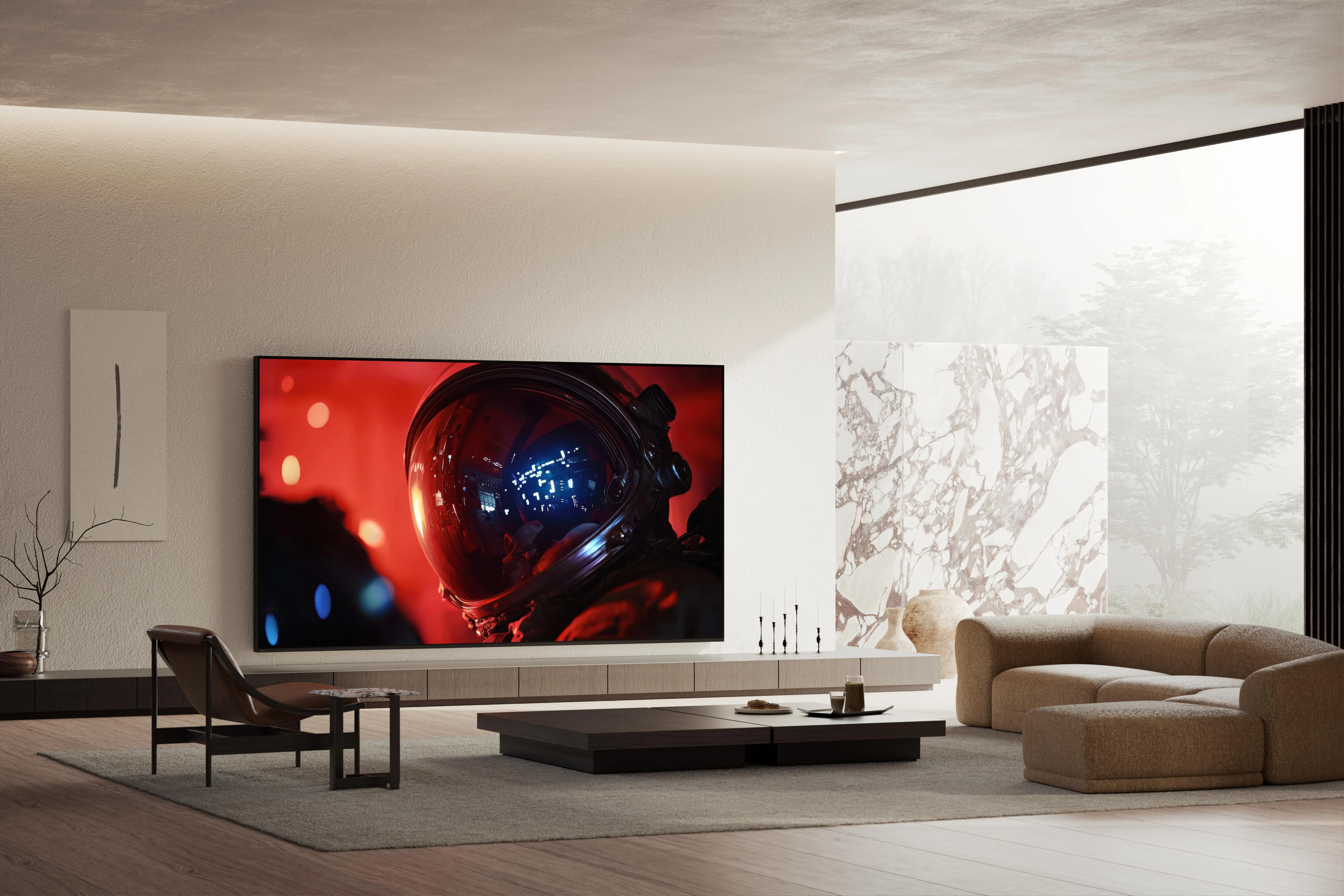

Sony True RGB is the company’s name for a television backlight built from individually controlled red, green and blue LEDs. Ordinary LED sets use one colour of LED and filter the light to make colour, which wastes brightness and dulls the result. True RGB skips that step, so colour arrives purer. Sony uses it in the Bravia 9 II and Bravia 7 II. Other brands call much the same idea Micro RGB or RGB Mini-LED.
What is Sony True RGB?
Sony True RGB is a backlight technology for LCD televisions. Instead of a single-colour backlight sitting behind the panel, it uses independently driven red, green and blue LEDs. Sony calls the control system RGB Backlight Master Drive Pro.
The advantage is straightforward. A conventional set makes white or blue light, then filters out everything it does not need. Besides wasting brightness, filtering blunts the colour. True RGB produces the right colour at source instead, so less is wasted on the way to your eyes.
Which Sony televisions use it?
Two ranges. The Bravia 9 II is the flagship and reaches up to 115 inches. The Bravia 7 II sits below it and covers the more usual living-room sizes.
Meanwhile, the Bravia 3 II and Bravia 2 II remain conventional LED sets. They still run Google TV, with the same app support, but they use neither True RGB nor Mini-LED backlighting.
What does Sony True RGB actually improve?
Three things, in our experience of setting these up.
Colour volume. Sony claims the widest colour range in its television history. Yoshihiro Ono, who heads the company’s home entertainment business, describes the approach as combining individually controlled LEDs with the best of both Mini-LED and OLED.
Viewing angle. X-Wide Angle Pro holds colour and contrast steady when you sit off to one side. That has always been the weakness of LCD televisions, so it is the improvement most people notice first in the showroom.
Reflections. Immersive Black Screen Pro cuts down on reflected light. In a bright room, that does more for the picture than raw brightness figures suggest.
The sets also sense ambient light and adjust brightness and colour tone as conditions change through the day.
Is Sony True RGB the same as Micro RGB?
Essentially, yes. Samsung calls its version Micro RGB, LG uses Micro RGB evo, and some brands market it as RGB Mini-LED. All describe a backlight made from separate red, green and blue LEDs.
The engineering differs in the detail, though the principle is shared. Our guide to Micro RGB and the new screen technologies covers how these compare with OLED and QLED if you want the wider picture.
What about Sony OLED?
Sony has put its flagship effort into True RGB rather than OLED, so the Bravia 8 II remains the one to look at if OLED is what you want. It is still, of course, an excellent television.
Which suits you depends on the room. True RGB goes far brighter and holds up in daylight, while OLED gives perfect blacks and suits darker rooms and film watching. If you want German-built OLED with configurable mounting, our piece on the Loewe Antares range is worth a read too.
Sound to match
Sony has refreshed its Bravia Theatre range alongside the televisions, including new soundbars, rear speakers and subwoofers. You can now run two subwoofers from a single Sony soundbar, which helps enormously in awkwardly shaped rooms.
These pair automatically with a Bravia set, so the television and soundbar work as one system rather than two boxes that happen to sit together.
Come and have a look
Brightness figures on a spec sheet tell you very little. What matters is how a television copes with your room, your windows and where your sofa sits.
We keep Sony running alongside Samsung and Loewe in our St James’s Parade showroom, on identical content, so you can compare them properly. Bring a photograph of the room if you can.
Call 01225 331 441 or get in touch to arrange a demonstration.
Frequently asked questions
Is Sony True RGB better than OLED? Neither wins outright. True RGB goes much brighter and suits sunny rooms, while OLED produces perfect black and suits dark rooms. The room should decide it.
Can a True RGB television get burn-in? No. Burn-in affects organic OLED pixels, and these sets use inorganic LEDs, which do not degrade the same way.
Does Sony True RGB need a special HDMI cable? Usually not. A certified Ultra High Speed HDMI cable handles 4K at 120Hz comfortably. Only 8K or very high frame rates call for anything newer.
Does Sony True RGB work with Freeview? Yes. Every television sold here includes a Freeview tuner, and Google TV adds the streaming apps on top. Our guide to Freeview on a smart TV without an aerial covers properties with no aerial connection.
Which Sony should I buy for a bright room? A True RGB set, if the budget allows. Failing that, look at how much daylight actually falls on the screen before ruling OLED out. We are happy to advise.


