
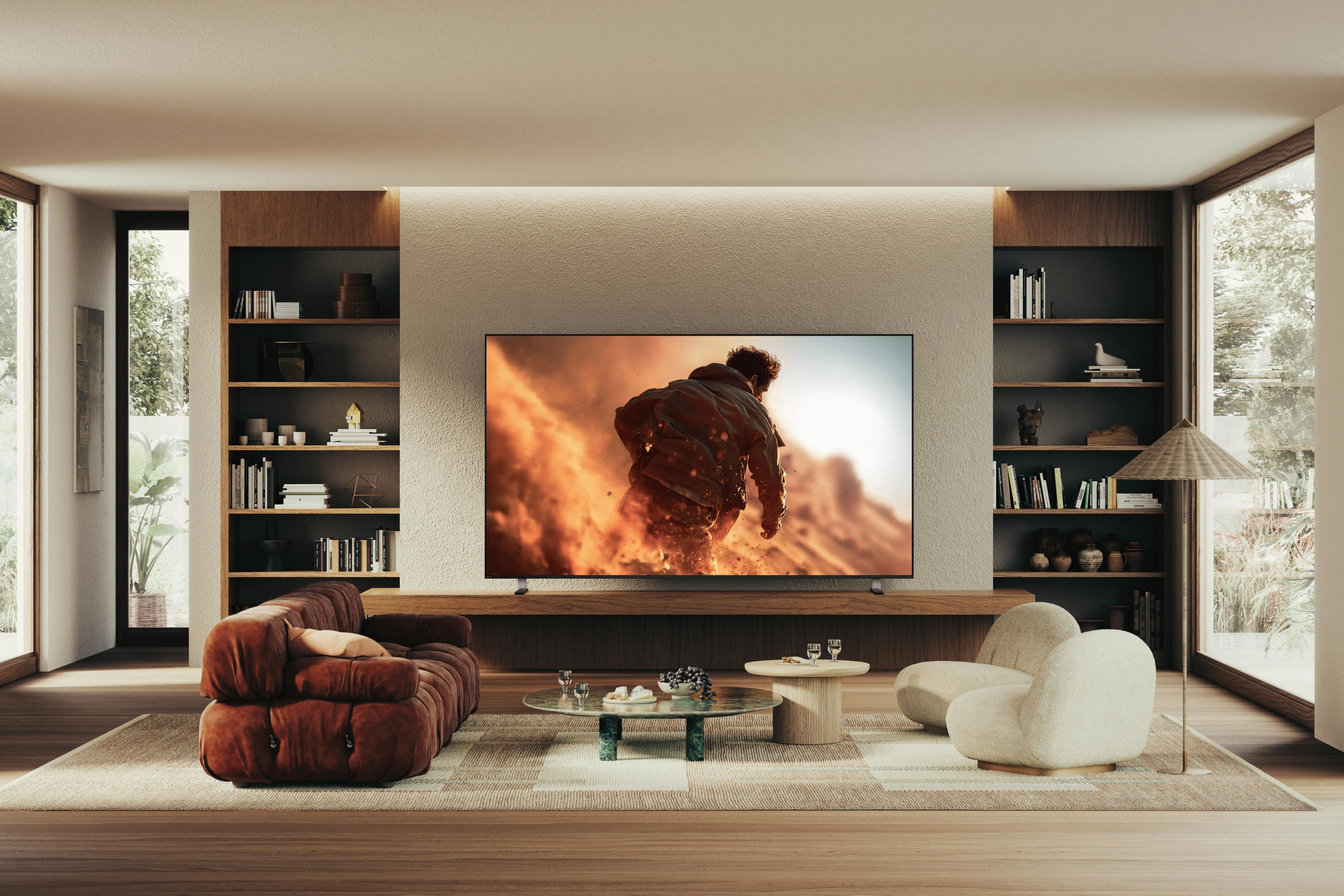

Micro RGB is a new kind of TV backlight. It uses thousands of tiny red, green and blue LEDs behind an LCD panel. Ordinary LED and QLED sets use white or blue LEDs instead, then filter that light to make colour. The new approach gives purer colour and much higher brightness. Samsung launched the first sets in 2026, and Sony followed with its own version. OLED works in a completely different way, because every pixel makes its own light. So OLED still wins on black levels, while Micro RGB wins on brightness. Your room decides which one matters more.
Every few years the television industry invents a new word. This year it is Micro RGB. Walk into our showroom on St James’s Parade and the labels now read OLED, QLED, Mini-LED and one more besides. That is four competing terms for what most of us just call a telly!
What is Micro RGB?
Micro RGB is a backlight technology for LCD televisions. It replaces the single-colour backlight with thousands of separate red, green and blue LEDs, each of which can dim or brighten on its own. The panel in front still forms the image, but it now receives light that is already the right colour.
That last point matters most. A normal LED TV starts with white or blue light, then uses a filter to strip out everything except the colour needed. Besides being wasteful, that filtering dulls the result. The new backlight skips most of the waste, so colour arrives purer and the picture gets brighter.
Why does every brand call it something different?
Because nobody agreed on a name. Samsung says Micro RGB. Sony calls its version True RGB. LG uses Micro RGB evo, and some brands market it as RGB Mini-LED. All four describe the same basic idea.
Sony’s launch, announced in May 2026, covers two ranges. The Bravia 9 II runs from 65 inches up to 115, while the Bravia 7 II starts at 50”. Samsung’s Micro RGB line spans 55 to 115 inches.
How bright are the new sets?
Very bright indeed. Some models are rated at up to 10,000 nits of peak brightness, where a good OLED typically peaks between 1,500 and 2,500 nits. That is a wide gap on paper, although you will rarely see the full figure outside a test pattern.
Colour has moved on too. Yoshihiro Ono, who heads Sony’s home entertainment business, describes True RGB as combining individually controlled LEDs with the best of both Mini-LED and OLED. Sony claims the largest colour volume in its television history. The company also says the wider viewing angle holds colour steady across the room, which has long been the weak spot of LCD sets.
How is Micro RGB different from OLED?
OLED has no backlight at all. Each pixel creates its own light and can switch off completely, which produces perfect black, because an off pixel emits nothing. Micro RGB always has a backlight, so a little light can leak into dark areas.
By contrast, the trade runs the other way on brightness. OLED pixels are organic and have to be driven gently to protect their life, while the LEDs in a backlight are inorganic and can be pushed far harder.
Is Micro RGB just Mini-LED renamed?
No, though the confusion is fair. First, Mini-LED describes the size of the backlight LEDs. Second, Micro RGB describes their colour. A Mini-LED set uses lots of very small LEDs, but they are all one colour, whereas the newer sets use lots of very small LEDs in three colours.
Most of them are Mini-LED sets as well. The RGB part is the upgrade. If you see a TV sold as RGB Mini-LED, that is the same idea under a different label.
Where does QLED fit in now?
QLED is a quantum dot layer added to an LCD panel. It converts backlight into richer colour. Samsung introduced the term in 2017, and it has been the mainstream premium badge ever since.
Quantum dots have not gone away. Many sets use both, with an RGB backlight feeding a quantum dot layer. QLED simply sits in the middle of the market now rather than at the top. Our full OLED vs QLED guide still covers that comparison properly, and it remains the right choice for most budgets.
Is OLED finished?
Not remotely, but the picture has shifted. Sony has put its effort into True RGB rather than OLED, so the Bravia 8 II remains its best OLED for now. If Sony OLED is what you want, that is the TV to look at.
Loewe has gone the other way entirely. The German brand builds its own OLED modules by hand in Kronach and has stayed with the technology. Its new Antares range reached the UK in July 2026, in 42, 48, 55 and 65-inch sizes. Antares brings the Loewe design language within reach of far more people, with 144Hz gaming, Dolby Vision and the motorised floor stands the brand is known for.
Above that sits the Stellar range, still made in Germany and still, to our eyes, among the finest pictures money can buy. So OLED is not retreating. It is simply specialising.
Which screen suits your room?
Still, room comes first and specification second. After installing televisions in hundreds of homes, we find the room matters far more than anything printed on the box.
Bright rooms with large windows. Georgian sash windows throw a lot of light about. Micro RGB or a good Mini-LED will hold up well. OLED can look washed out in the worst cases, though recent panels have improved.
Dedicated cinema rooms. OLED, almost every time. Black level is, after all, what makes a film look like a film.
Wide seating and family living rooms. OLED has always held colour better from an angle. Sony claims to have largely closed that gap with True RGB, so this one is worth judging with your own eyes rather than on paper.
Very large screens, 85 inches and up. Micro RGB is the practical pick. Both Samsung and Sony now reach 115 inches, and OLED gets expensive fast at that size.
Come and see the difference
Of course, specifications only tell you so much. Two televisions can measure much the same and look nothing alike in a real front room.
We keep Samsung, Sony and Loewe sets running side by side in our St James’s Parade showroom, on the same content. Bring a photo of your room if you can, because window position changes the answer more often than people expect.
Pop in, or give us a call on 01225 331 441.


