
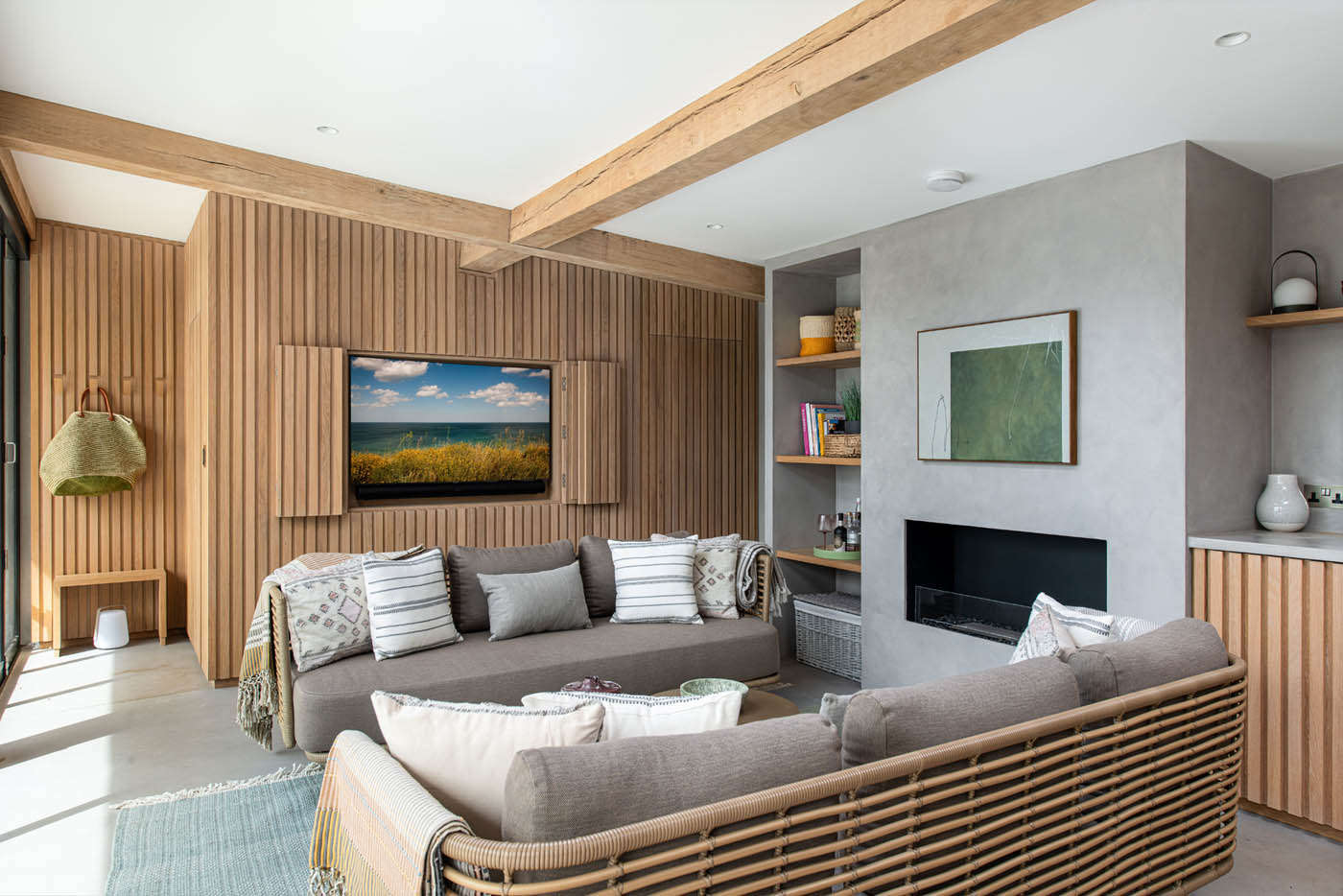

You don’t need a basement or a spare room the size of a tennis court to enjoy a proper home cinema. Some of the best cinema rooms we’ve installed over the years have been in spaces most people would write off – box rooms, alcoves, even sections of open-plan living areas that weren’t doing much of anything.
The reality of UK housing is that most of us are working with compact rooms. And that’s fine. A small cinema room can actually deliver a more immersive experience than a large one, partly because you’re closer to the screen and partly because the acoustics of a smaller, enclosed space tend to work in your favour.
Here are our small home cinema ideas for making the most of whatever space you have available.
Choosing the Right Screen for a Small Cinema Room
The screen is where everything starts, and in a smaller room you have two main options: a television or a projector.
For most small cinema room ideas, we recommend a high-quality TV between 55 and 77 inches. Modern OLED and QLED panels from brands like Sony, LG, Samsung, Panasonic and Loewe deliver picture quality that rivals what you’d see in a commercial cinema.
OLED screens are particularly well suited to cinema rooms because they produce perfect blacks. When a scene goes dark, the pixels switch off completely rather than glowing a murky grey. If you’re interested in the differences between display technologies, our OLED vs LED comparison explains them in detail.
Wall-mounting the TV frees up floor space and gives the room a cleaner feel. We’ve written a separate guide on wall-mounting on plasterboard if that’s relevant to your property, and our installation team handles the bracket fitting, cable routing and calibration as part of our service.
For those who want a truly cinematic screen size without giving up half the room, ultra short-throw projectors are a great option. These sit just centimetres from the wall and throw a picture up to 120 inches across.
They’re ideal for cinema rooms where there’s no ceiling space for a traditional projector mount. The trade-off is that they work best with an ambient light rejecting screen, and picture quality in bright conditions won’t match a good TV. But in a darkened room, the effect is stunning.
If you’d like more detail on how short-throw projectors work, we covered this in our short-throw projector guide.
Sound Systems That Work in Compact Spaces
Good sound is what separates watching a film from experiencing it. The good news is that small rooms are often easier to fill with quality audio than large ones.
A well-chosen soundbar with a wireless subwoofer is a surprisingly effective home cinema solution for smaller rooms. The latest models from Sony, Samsung and Sonos support Dolby Atmos processing. This creates a sense of height and movement in the soundtrack without needing physical speakers mounted on the ceiling. In a compact room where you’re sitting relatively close to the soundbar, the effect can be remarkably convincing.
Where space and layout allow, a 5.1 surround sound system takes things further. Five speakers and a subwoofer, positioned correctly, place you inside the soundtrack rather than in front of it. In a small cinema room, the rear speakers don’t need to be large. Compact satellite speakers or in-wall models do the job without dominating the space. Our home cinema installation team can advise on what’s appropriate for your specific room.
Dolby Atmos systems with overhead channels add another dimension entirely. A 5.1.2 or 7.1.4 configuration places sound above and around you. This is where a dedicated cinema room, even a small one, really comes into its own. The contained space means every speaker works harder and the effect is more enveloping than it would be in a large, open room.
Making the Most of a Multi-Use Room
Not everyone has the luxury of a dedicated cinema room, and many of our home cinema installations sit within living rooms, studies and bedrooms that serve other purposes during the day. This is one of the most common small home cinema ideas we work with, and it calls for some thoughtful planning.
A retractable projector screen is one solution. It rolls down over a wall or window when you want a cinema night and disappears when you don’t. Combined with a ceiling-mounted projector, the room can switch between its everyday function and a cinema setup within moments.
If a TV is your screen of choice, consider how it integrates with the room when it’s not in use. Loewe, for example, build televisions that are designed as furniture pieces as much as technology. They look right in a living space even when switched off.
For multi-use rooms, a soundbar is often more practical than a full surround system. It keeps the footprint small and avoids the need for speakers dotted around a room that also needs to function as a lounge or study.
The key is making the technology feel like it belongs in the room rather than taking it over. That’s where professional installation makes a real difference – concealed cables, neatly integrated speakers and a control system that doesn’t require three remotes and a degree in engineering.
Light Control: The Detail That Changes Everything
It’s easy to focus entirely on the screen and speakers and overlook lighting, but it has an enormous impact on how your home cinema looks and feels.
For the best picture quality, you need the ability to block out natural light. Blackout blinds or heavy curtains are the simplest solution. In period properties – and we work in a lot of them across Bath and the South West – shutters can work well too, and they suit the character of older buildings.
Ambient lighting around the room adds atmosphere without interfering with the picture. LED strip lighting behind the TV or along the base of walls creates a subtle glow that reduces eye strain during long viewing sessions and looks the part. Bias lighting behind the screen is a small addition that makes a noticeable difference to how comfortable the picture feels, particularly in a dark room.
Acoustic Treatment: When It Matters
Room acoustics affect sound quality more than most people realise. Hard surfaces, like stone walls, wooden floors, and large windows, bounce sound around and create echoes that muddy dialogue and wash out the detail in a soundtrack. Soft furnishings absorb some of this, but in a room with a lot of reflective surfaces, targeted acoustic treatment is worth considering.
Acoustic panels come in a variety of finishes and can be mounted on walls or ceilings without looking out of place. In fact, some of the fabric-wrapped panels available today double as a design feature. Heavy curtains, thick rugs, and upholstered furniture all contribute to the acoustic character of a room and help tame reflections.
In Bath’s Georgian and period properties, where stone walls and high ceilings are common, we find that even modest acoustic treatment makes a significant improvement to how a system sounds. Our guide to room acoustic treatments goes into more detail on the options available.
Seating and Layout
If you’re planning regular film nights, the difference between a sofa you perch on and one you sink into is the difference between watching half a film and watching the whole thing.
In a dedicated cinema room, even a small one, recliners with built-in cup holders and USB charging bring a touch of the commercial cinema experience. Two or three good recliners can fit comfortably in a compact room and they look the part.
For rooms that double up, a deep, generous sofa works well – ideally one where you can put your feet up. L-shaped sofas are popular in cinema setups because they give everyone a decent viewing position without needing rows of seats.
Placement matters too. You want the seating positioned so that the centre of the screen is roughly at eye level when you’re seated, and you want to be close enough that the screen fills a good portion of your field of vision. This is one of the advantages of a smaller room: you naturally end up at the right sort of distance.
Smart Control and Cable Management
Nothing undermines a cinema room faster than a tangle of cables and a coffee table covered in remote controls. Modern smart home integration solves both problems.
A universal control system lets you manage your TV, sound system, streaming devices and lighting from a single app on your phone or tablet. Press one button and the lights dim, the screen switches on, and the sound system sets itself to the right input. We install these systems regularly and they make a genuine difference to how much the room gets used. If it’s easy to start a film, you’ll do it more often.
Cable management is the other essential. Our installation team conceals cables within walls, behind skirting boards and through conduit so that nothing is visible. In older properties this takes careful planning – there’s often stonework, lath and plaster, or listed building considerations to work around – but it’s something we’ve been doing across Bath and the South West for decades.
If you’re curious about smart TV setup and connectivity more broadly, our Smart TV aerial guide covers how everything connects together.
Getting Started With Your Home Cinema
The best small home cinema ideas start with the room itself. Every space is different, and the right combination of screen, sound and layout depends entirely on the shape, size and character of yours.
Our approach at Moss of Bath is straightforward. We start with a free site visit to look at the space, talk through what you’d like to achieve, and make recommendations based on what we’ve learned from over 60 years of home cinema installations across Bath and the surrounding areas. You’ll receive a detailed proposal, usually within 48 hours, and from there our in-house team handles everything from installation to calibration. Whether it’s a dedicated cinema room in a period property or a corner of an open-plan living space, we’ll help you find the setup that works.Get in touch to arrange a visit, or pop into our showroom on St James’ Parade to see and hear some of these systems for yourself.


